Our Research
The goal of the Chui SAMS Lab is to improve medication safety in the pharmacy setting by developing a more solid conceptual foundation for understanding medication errors in community pharmacies.
This is an accordion element with a series of buttons that open and close related content panels.
Understanding Systemic Factors of Medication Errors
There are approximately 88,000 pharmacies across the United States dispensing 87.5 million prescriptions each week. Pharmacists support the health of patients and the public by:
- Acting in the community as medication experts.
- Verifying the accuracy and appropriateness of medications.
- Communicating critical information to patients about how to take their medications.
Unfortunately, pharmacies can be chaotic work environments where any pharmacist would struggle to manage the day-to-day activities of taking care of patients and filling prescriptions. It is critically important to prevent medication errors that occur in the pharmacy.
Medication errors occur in 1.7%-22% of dispensed prescriptions. Of these errors, 6.5% are clinically significant. Using the most conservative estimate, this translates to approximately 51.5 million dispensed prescriptions with errors annually at an estimated cost of over $877 million. (Figure 1)
Figure 1
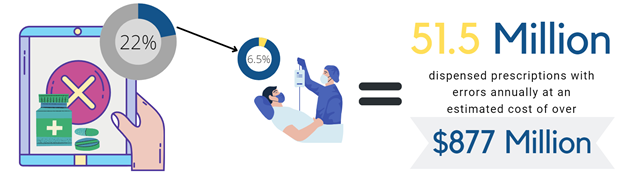
Figure 1. Cost of dispensing errors
Managing Dispensing Errors
- Access to patient information and treatment history.
- Decision-making power when managing a patient’s treatment regimen.
In order to reduce medication errors in community pharmacies, we must first develop a deep understanding of underlying reasons that lead to errors in the first place. By understanding these underlying reasons, we can most importantly use evidence to shift the (inappropriately placed) blame away from humans—as patients, providers, employees—to the system within which they operate.
Innovative Approach Using HFE (Human Factors Engineering)
The Chui SAMS Lab applies concepts from the scientific disciplines of human factors engineering (HFE) and industrial and health systems engineering, to improve patient safety in the community pharmacy setting. We are one of the first research groups to adopt HFE concepts beyond the hospital and primary care setting, to address medication safety in community pharmacies.
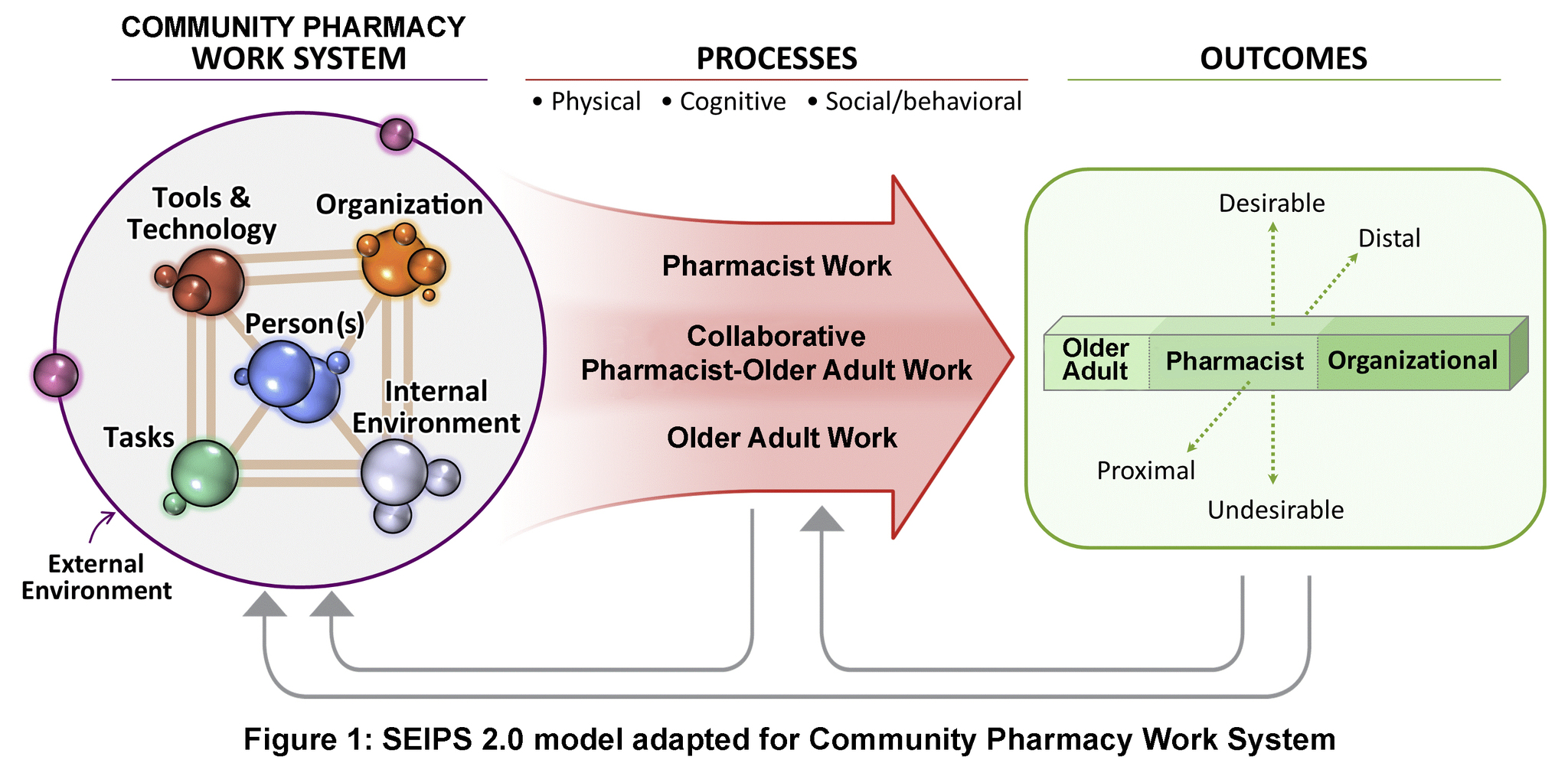
Systems Engineering Initiative for Patient Safety (SEIPS 2.0) Model (Figure 2)
Human factors engineers have conceptualized a framework to examine key elements of a work system which include:
-
-
-
-
- Tools and technology
- Physical layout
- Organizational culture
- Skills of workers
- Task characteristics
-
-
-
Work system elements interact to influence care processes, such as patient communication and counseling, which in turn impact both patient-specific outcomes, such as safety, and worker-specific outcomes, such as job satisfaction.
By applying HFE concepts to our research, we are able to look beyond the skills and knowledge of the individual pharmacist as the sole determinant of medication safety and focus on components of the work system as potential contributing factors to medication safety. We can explore work system influences that positively and/or negatively impact the work of pharmacists, which in turn, could influence medication safety.
Figure 2